
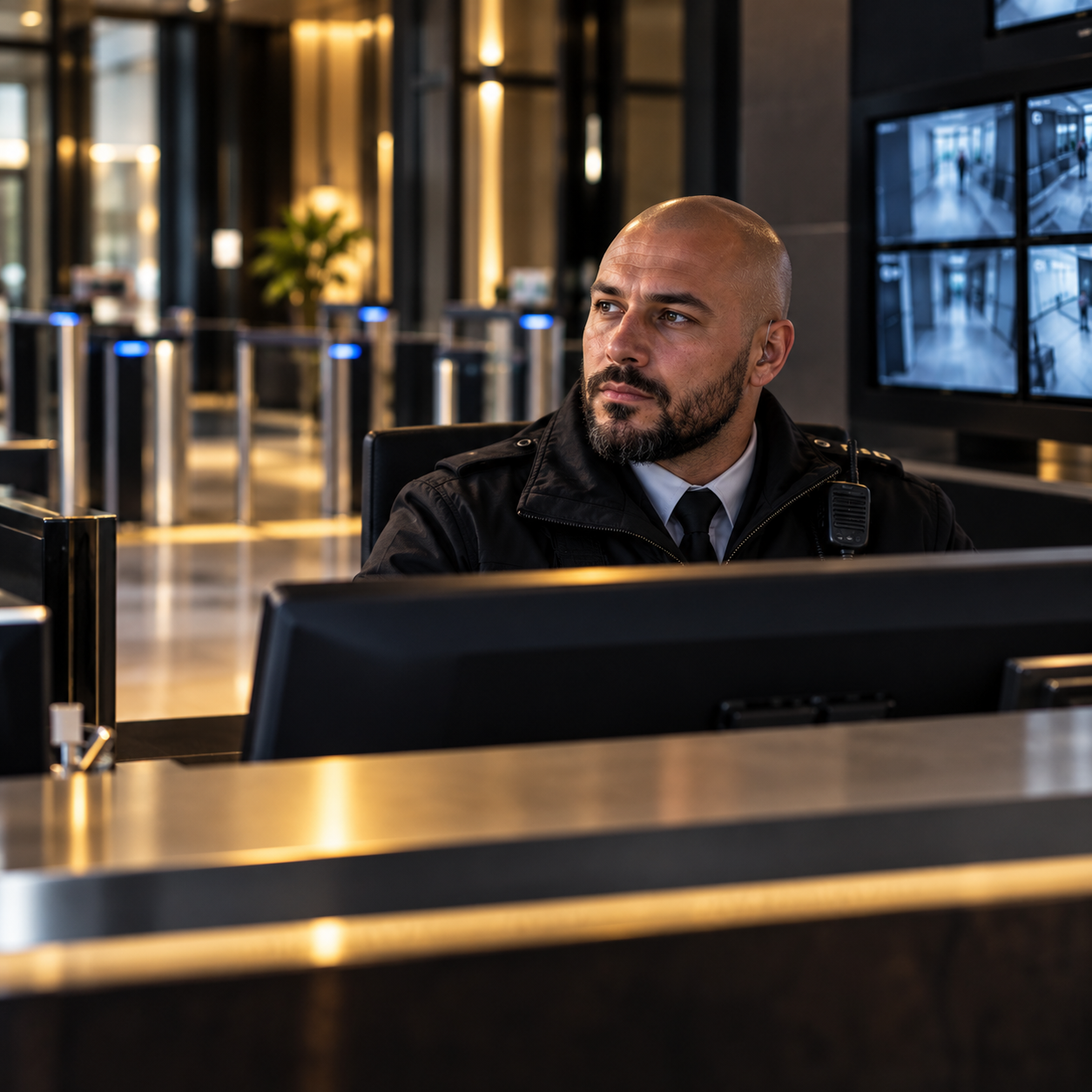
Behind the Desk
DOCUMENT PURPOSE
Corporate security can look quiet from the outside. The reality may include long shifts, permanent nights, lone working, access-control conflict, emergency responsibility, patrols, control-room work, prolonged vigilance, contract uncertainty and the pressure of being expected to notice the one thing that matters.
Behind the Desk is a wellbeing and mental-strength manual for Security Officers working in corporate offices, commercial buildings, reception/front-of-house security, control rooms, campuses and similar guarding environments.
It is not a tactical security manual. It does not teach restraint, searching tactics, weapons response, counter-terrorism tactics, surveillance techniques or use of force. Those areas belong to SIA licence-linked training, employers, site procedures and appropriately qualified specialists.
Behind the Desk
EVIDENCE RULES
- Direct UK SIA/HSE evidence is used first.
- Security-guard studies from outside the UK are labelled international evidence and are not converted into UK prevalence.
- Police, military, construction and other occupations are not presented as corporate-security evidence.
- No UK Corporate Security Officer prevalence figure for PTSD, depression, anxiety, burnout or suicide is invented.
- Association is not presented as causation.
- Spartan does not diagnose.
- Psychologically focused debriefing is not recommended as a PTSD prevention/treatment intervention.
- Peer support complements rather than replaces professional care.
- Practical Spartan frameworks are labelled as practical frameworks, not clinically validated treatments.
Behind the Desk
FOUNDER’S NOTE
Corporate security is easy to underestimate because the best nights often look uneventful.
People arrive, people leave, doors open, alarms are dealt with, incidents are managed and the building is still standing in the morning. What is less visible is the officer who stayed alert through the quiet hours, worked while everybody else slept and carried the responsibility when there was nobody else nearby.
This manual is for that person.
Professionalism is not pretending that night work, isolation, violence, fatigue or responsibility never affect you. Professionalism includes noticing when something has changed and dealing with it before it becomes a bigger problem.
Look after the building. Look after the public. Look after the person beside you. And do not forget yourself.
Richard HallFOUNDER, SPARTAN BROTHERHOOD
NO MAN FIGHTS ALONE.
Part I
THE INVISIBLE SHIFT
1 WHEN NOTHING HAPPENS
Quiet does not mean responsibility disappears. Corporate guarding can require sustained readiness during long periods of low stimulation.
International security-guard research has identified both high demands and underload among occupational stressors. This does not prove that boredom causes illness; it supports treating underload and vigilance demands as legitimate work-design issues.
Your job is not to manufacture stimulation. It is to manage alertness safely and follow site procedures.
2 THE PERSON BEHIND THE UNIFORM
Know your normal baseline: sleep, mood, patience, concentration, physical discomfort, appetite, alcohol or substance use, relationships, motivation and social contact.
A change is not automatically a disorder. Persistent or worsening change that interferes with ordinary life deserves attention.
3 RESPONSIBILITY WITHOUT APPLAUSE
Security work often succeeds by preventing or managing problems before most people notice them.
Low recognition can feel frustrating, but this manual does not claim that low status causes mental illness. Focus on what can be controlled: professional standards, team culture, support, development and life outside the role.
Part II
NIGHTS, SLEEP & FATIGUE
4 THE NIGHT-WORK BODY
HSE identifies sleep loss and fatigue as major issues for shift workers. Daytime sleep is commonly lighter, shorter and more easily disturbed than night sleep.
Older research in 197 male permanent night security guards in Sweden found sleep disturbance and fatigue occurred more often than in a representative male working sample. This is direct occupation evidence but international and historical, so it is not a UK prevalence estimate.
5 FATIGUE IS A SAFETY ISSUE
Fatigue can affect alertness, judgement and performance. On nights and early mornings, reduced alertness can increase the risk of errors, injury and accidents.
HSE recommends managing fatigue as an occupational hazard rather than relying solely on Working Time Regulations.
6 THE DRIVE HOME
HSE warns that driving after long or night shifts can be risky.
If you are too sleepy to drive safely, do not turn the journey into a test of toughness. Consider safer transport, share driving where possible, or stop safely rather than forcing yourself onward.
7 BUILD A SLEEP SYSTEM
Protect daytime sleep: darkness, reduced noise, a suitable temperature and a repeatable sleep routine can help.
Use caffeine strategically rather than endlessly. HSE advises avoiding caffeine close to sleep and warns against relying on stimulants to stay awake.
Alcohol may make sleep start sooner but can disrupt sleep quality; it is not a recovery system.
Part III
LONE WORKING & ISOLATION
8 ALONE IN A FULL BUILDING
HSE explicitly lists security staff among lone workers and says employers must manage risks before people work alone.
Lone working does not automatically make violence more likely, but HSE says it can make workers more vulnerable because nearby support may not be available.
9 DISCONNECTED, ISOLATED, ABANDONED
HSE warns that poor contact with managers and colleagues can leave lone workers feeling disconnected, isolated or abandoned and can affect performance, stress and mental health.
Regular contact is therefore not administrative theatre. It is part of good lone-worker management.
10 WHEN THE RADIO IS YOUR LIFELINE
Follow site check-in, escalation and emergency procedures. Know how assistance is summoned and what happens if you fail to check in.
This manual does not prescribe operational response intervals because risks differ by site. Employers should determine appropriate supervision and monitoring through risk assessment.
Part IV
VIGILANCE, CONTROL ROOMS & ATTENTION
11 WATCHING FOR THE ONE THING
Security officers may spend long periods monitoring routine activity while remaining responsible for recognising unusual events.
Evidence specifically quantifying the psychological effect of corporate-security CCTV vigilance is limited. We therefore do not invent a 'vigilance fatigue' diagnosis or prevalence statistic.
Use authorised breaks, task rotation and movement where operationally permitted.
12 SCREENS, SITTING & MOVEMENT
Control-room and reception work can involve prolonged sitting and screen use. Treat workstation setup, breaks and movement as occupational-health matters rather than signs of weakness.
Do not diagnose cardiovascular or musculoskeletal disease from the job. Raise persistent pain, visual problems or health concerns through appropriate occupational-health or medical routes.
13 THE 04:00 DIP
Night workers can find it difficult to remain alert. HSE suggests bright light, regular short breaks where possible, getting up and walking during breaks, planning more stimulating tasks during drowsy periods and keeping contact with co-workers.
These are practical alertness measures, not substitutes for adequate rest or safe staffing.
Part V
CONFLICT IN CORPORATE SECURITY
14 ‘I WORK HERE’
Access-control decisions can create conflict with employees, contractors, visitors and members of the public.
HSE defines work-related violence broadly enough to include abuse and threats, not only physical assault.
Professionalism does not require accepting abuse as harmless.
15 WHEN IT BECOMES VIOLENT
HSE identifies security staff who enforce rules as a workplace-violence risk group, especially where they work alone or late.
International research combining police officers and security guards found associations between workplace violence and psychological distress. It is relevant adjacent security evidence, not a UK corporate-security prevalence figure.
16 AFTER THE INCIDENT
First deal with immediate safety, injury, medical needs, reporting and evidence in accordance with site procedures.
Then recognise the welfare side. People can react differently after frightening incidents. Do not assume that completing the shift means there was no impact.
Part VI
EMERGENCIES & RESPONSIBILITY
17 WHEN YOU ARE FIRST THERE
Security officers may encounter alarms, fire-related events, intruders, medical emergencies, vulnerable people or other serious incidents.
Current SIA Security Officer refresher requirements include terror-threat awareness, searching and vulnerability training, with valid Emergency First Aid at Work or equivalent required before refresher training.
This manual supports wellbeing around those responsibilities; it does not replace operational training.
18 TERRORISM WITHOUT HYPE
Counter-terrorism awareness is part of current SIA licence-linked/refresher expectations for Security Guards.
Martyn’s Law has received Royal Assent, but as of September 2026 it is not yet in force. The SIA is preparing for expected commencement in spring 2027. Do not tell officers or premises that the new duties are already live.
19 AFTER A SERIOUS EVENT
Trauma does not automatically mean PTSD. Some reactions settle naturally; others become persistent or severe.
NICE says psychologically focused debriefing should not be offered to prevent or treat PTSD. Operational debriefing for facts, learning and safety is different from compulsory emotional processing.
Part VII
STRESS WITHOUT THE DRAMA
20 WHAT WORK STRESS ACTUALLY MEANS
HSE's Management Standards identify six areas of work design: demands, control, support, relationships, role and change.
That framework fits corporate security particularly well: workload and shifts; limited control; supervisor/client support; team/client relationships; clarity of role; and repeated contract/site change.
21 HIGH DEMAND AND UNDERLOAD
Security work can alternate between intense responsibility and very low stimulation. International research in 399 Serbian male security guards found both high demands and underload among occupational stressors associated with health/work-ability measures.
Those results must not be treated as UK prevalence or proof that a particular shift pattern caused disease.
22 WHEN WORK STARTS CHANGING YOU
Notice persistent changes in sleep, mood, patience, concentration, reliability, motivation, social contact, drinking/substance use or ability to enjoy ordinary life.
Do not diagnose yourself from a checklist. Use changes as a reason to check what is happening and seek qualified help where needed.
Part VIII
BODY & HEALTH
23 THE SEDENTARY SHIFT
Some corporate posts involve hours of sitting; others involve long patrols or standing. The physical demand depends on the assignment.
Build movement into authorised breaks where practical, maintain ordinary physical activity outside work and raise persistent symptoms appropriately.
24 NIGHT-SHIFT FOOD
HSE recommends considering meal timing and quality during shift work. Large, heavy meals can increase drowsiness; hydration matters for mental and physical performance.
Do not chase alertness with an endless cycle of sugar and energy drinks.
25 HEALTH CHECKS FOR NIGHT WORKERS
UK rules require employers to offer a free health assessment before someone becomes a night worker and regular assessments thereafter. Workers do not have to accept.
If a health professional confirms that night work is affecting a worker’s health, the employer must, where possible, find suitable alternative work.
Part IX
CONTRACTS, CHANGE & JOB SECURITY
26 WHEN THE CONTRACT CHANGES
Corporate security is frequently outsourced. A site contract may be retendered, insourced or moved to another provider.
TUPE can apply to security service-provider changes where the legal conditions are met. This manual does not give individual legal advice; use Acas, a union where applicable or qualified employment advice for a specific case.
27 NEW UNIFORM, SAME DESK
A contractor change can bring uncertainty about managers, systems, pay, rotas, culture and future employment.
HSE identifies 'change' as one of its six work-stress Management Standards. Employers should communicate and manage organisational change properly.
28 SPEAKING UP
Security officers should be able to raise genuine safety, malpractice and welfare concerns without a culture of intimidation.
As of June 2026 the SIA has prescribed-person status for protected whistleblowing within its private-security regulatory remit. Whether a particular disclosure is legally protected depends on the circumstances; obtain proper advice rather than relying on this manual.
Part X
LIFE OUTSIDE SECURITY
29 WHEN EVERYONE ELSE IS AWAKE
Shift work can separate workers from normal family and social routines. HSE advises maintaining contact and helping family and friends understand the shift schedule.
Do not claim the job causes relationship breakdown. Protect recovery and deliberately protect relationships.
30 WHAT DO YOU USE TO SWITCH OFF?
Alcohol, scrolling, gambling, overeating, substances, sleeping medication or constant overtime can become ways of changing state after work.
Notice escalation, secrecy, loss of control or consequences. HSE specifically advises against using alcohol or sedatives as routine sleep aids.
31 MORE THAN A SECURITY OFFICER
Keep an identity outside the site: relationships, training, hobbies, learning, community and future goals.
Your value is not measured by how many night shifts you can absorb.
Part XI
TRAUMA, DISTRESS & SUPPORT
32 PTSD: DON’T SELF-DIAGNOSE
PTSD can involve intrusive memories, nightmares, avoidance and heightened arousal, but diagnosis belongs to qualified professionals.
NICE-supported treatments for adults include trauma-focused CBT and EMDR in appropriate circumstances.
33 THE COLLEAGUE WHO HAS CHANGED
If someone becomes unusually withdrawn, angry, exhausted, reckless, hopeless or increasingly dependent on alcohol or substances, check in.
These signs do not prove a diagnosis. They are reasons not to ignore the person.
34 ASKING ABOUT SUICIDE
If you are seriously worried about someone, asking directly about suicide does not plant the idea in their head. NHS England explicitly addresses this myth.
Listen without ridicule or judgement. Do not promise secrecy where immediate safety is at stake. If there is immediate danger to life, call 999.
Part XII
THE CORPORATE SECURITY RESET
35 THE 60-SECOND CHECK
- SLEEP — am I recovering?
- ALERTNESS — am I struggling to stay awake?
- BODY — am I stiff, sore or inactive?
- HEAD — has my mood changed?
- TEMPER — am I unusually irritable?
- HOME — am I present with people?
- COPING — what am I using to switch off?
- TEAM — am I connected or isolated?
- WORK — am I making unusual mistakes?
- SAFETY — am I thinking about harming myself or not wanting to be here?
This is a reflection tool, not a diagnostic instrument.
36 AFTER A BAD SHIFT
Safety first. Medical care where needed. Follow reporting and evidence procedures.
Over the following days, notice sleep, intrusive memories, avoidance, mood, anger, coping and functioning. There is no universal '72-hour rule' that diagnoses trauma.
Seek qualified help if difficulties are severe, worsening, persistent or significantly interfering with life.
37 RESET
- DECOMPRESS — create separation from the shift.
- RECOVER — protect sleep, food, hydration and movement.
- RECONNECT — stay part of life outside security.
- REVIEW — notice meaningful changes.
- RESET — rebuild the routine before the next run of shifts.
This is a Spartan practical wellbeing framework, not a clinically validated treatment protocol.
Part XIII
FOR SECURITY COMPANIES, CLIENTS & MANAGERS
38 THE CLIENT HAS A DUTY TO SEE THE PERSON
Security officers should not become invisible simply because they are contracted staff.
Risk management should cover violence, lone working, fatigue, work-related stress, supervision, emergency arrangements and appropriate welfare.
39 CONTACT IS A CONTROL MEASURE
HSE says lone workers should be trained, supervised and monitored and employers should keep in touch and respond to incidents.
Good contact also helps managers recognise changes in stress and wellbeing.
40 FATIGUE CANNOT BE OUTSOURCED
A compliant rota is not automatically a safe fatigue system. HSE says Working Time Regulations alone are insufficient for managing fatigue.
Long hours, night work, consecutive shifts, commuting and second jobs may all matter to the real risk picture.
41 AFTER SOMETHING SERIOUS
Provide practical support, medical attention where needed, reporting routes, evidence preservation and welfare follow-up.
Do not force staff into compulsory emotional disclosure. Make professional support accessible and allow individual responses.
42 THE STANDARD
Corporate security protects people, information, assets and places. Responsible security management also protects the officers expected to do that work.
Wellbeing is not a substitute for standards. Done properly, it supports them.
Behind the Desk
FINAL WORD — BEHIND THE DESK
When everybody leaves the building, somebody is still there.
Somebody watches the cameras, checks the doors, answers the alarm, deals with the visitor, walks the empty floors and stays awake while the city sleeps.
That work matters.
So does the person doing it.
Notice the change. Check the person beside you. Use professional support when the problem needs more than a conversation.
NO MAN FIGHTS ALONE.
Behind the Desk
UK SUPPORT
Urgent mental-health help in England: use NHS 111 online or call 111 and select the mental-health option.
Samaritans: 116 123 — free, day or night, 365 days a year.
Shout: text SHOUT to 85258 — free, confidential, 24/7 UK text support.
CALM: 0800 58 58 58 — 5pm to midnight every day; also offers livechat/WhatsApp subject to current service arrangements.
Behind the Desk
FINAL EVIDENCE MATRIX
| EVIDENCE AREA | SOURCE | CLASSIFICATION | SAFE USE |
|---|---|---|---|
| SIA Security Officer licence/refresher | SIA/GOV.UK 2026 | DIRECT UK / GREEN | Security Guard licence uses Security Officer qualification; refresher required for renewal; valid EFAW/equivalent required. |
| Refresher content | SIA, updated 1 Apr 2026 | DIRECT UK / GREEN | Terror-threat awareness, searching knowledge/practical, vulnerability training. No DS-style physical-intervention refresher. |
| Lone working | HSE | DIRECTLY RELEVANT UK / GREEN | Security staff explicitly identified; manage violence, stress, wellbeing, supervision, monitoring and contact. |
| Lone-worker isolation | HSE | DIRECTLY RELEVANT UK / GREEN | Poor contact may produce feelings of disconnection/isolation/abandonment and affect performance/stress/mental health. |
| Workplace violence | HSE | DIRECTLY RELEVANT UK / GREEN | Security staff enforcing rules, late/early work and lone work are recognised risk contexts; threats/abuse included. |
| Night-worker legal framework | GOV.UK | UK REGULATORY / GREEN | Average 8-hour limit for night workers; special hazard/strain rules; free health assessments offered before and during night work. |
| Shift-work fatigue | HSE | UK OCCUPATIONAL / GREEN | Sleep loss/fatigue important issues; daytime sleep often shorter/lighter; alertness and commuting risks addressed. |
| Permanent night security guards | Alfredsson et al., 1991, PMID 1884708 | DIRECT SECURITY / AMBER | 197 Swedish male night guards; higher sleep disturbance/fatigue than comparison workforce; old/international. |
| Night security physiology | Italian security-guard study, PMID 31952337 | DIRECT SECURITY / AMBER | 90 guards; night work associated with altered cortisol/BP markers; international, limited sample. |
| Security-guard sleep | Delhi-NCR study, PMID 39264534 | DIRECT SECURITY / AMBER | 100 guards; night group poorer sleep/insomnia than day group; international, small cross-sectional study. |
| Security-guard mental health/sleep | Bengaluru 2026, PMID 41970011 | DIRECT SECURITY / AMBER | 171 guards; cross-sectional mental-health/sleep findings; do not use as UK prevalence. |
| Occupational stress | Serbia, PMID 30735105 / 33410781 | DIRECT SECURITY / AMBER | 399 male guards; occupational stressors associated with health/work-ability measures; international observational evidence. |
| Violence & distress | Leino et al. 2011, PMID 21846811 | SECURITY + POLICE / AMBER | 1,993 combined sample; violence associated with distress; not UK or corporate-security prevalence. |
| PTSD treatment/debriefing | NICE NG116 + NHS | CLINICAL UK / GREEN | No psychologically focused debriefing for prevention/treatment; trauma-focused CBT/EMDR evidence-based where indicated. |
| Work stress framework | HSE Management Standards | UK OCCUPATIONAL / GREEN | Demands, control, support, relationships, role, change. |
| Contract transfer | Acas TUPE | UK EMPLOYMENT / GREEN | Security contracts are a common service-provider-change example; TUPE applicability is fact-specific. |
| Martyn's Law | SIA/GOV.UK Jul 2026 | UK REGULATORY / GREEN | Act enacted; not yet in force; expected spring 2027. |
| Crisis routes | NHS/Samaritans/Shout/CALM | UK SUPPORT / GREEN | Current routes verified 8 Sep 2026; recheck immediately before publication. |
Evidence gaps — explicitly retained
- No reliable UK corporate-security-specific prevalence estimate for depression, anxiety, PTSD, burnout or insomnia was established.
- No reliable UK corporate-security-specific suicide rate was established.
- No validated corporate-security-specific 'vigilance fatigue' diagnosis or prevalence statistic was established.
- No robust evidence was established that corporate security causes relationship breakdown.
- No robust UK evidence was established that CCTV/control-room work itself causes a specific mental disorder.
- International security-guard health prevalence must not be transferred to UK officers.
- No causal claim should be made from cross-sectional security-guard studies.
- No universal post-incident 24/48/72-hour psychological rule is supported.
Behind the Desk
SOURCE REGISTER — CORE PUBLICATION SOURCES
- SIA. Check what training you need to get an SIA licence. GOV.UK. Current 2026 guidance.
- SIA. Changes to the delivery of SIA licence-linked training. Updated 1 April 2026.
- SIA. Renew your SIA licence. Updated 19 June 2026.
- HSE. Protecting lone workers / Lone working: violence, stress and other health factors.
- HSE. Hints and tips for shift-workers.
- HSE. Management Standards for work-related stress.
- GOV.UK. Night working hours: hours and limits; health assessments.
- NICE NG116. Post-traumatic stress disorder; recommendations and evidence.
- NHS. PTSD.
- NHS. Where to get urgent help for mental health.
- NHS England. Staying safe from suicide.
- SIA. Understanding Martyn’s Law and the SIA’s role as regulator. 17 July 2026.
- SIA. Strategic Plan 2026–2029.
- Acas. TUPE: service provider changes.
- Alfredsson L, Akerstedt T, Mattsson M, Wilborg B. Self-reported health and well-being amongst night security guards. Ergonomics. 1991. PMID 1884708.
- Leino TM et al. Violence and psychological distress among police officers and security guards. Occup Med (Lond). 2011. PMID 21846811.
- Jovanović J et al. Occupational stress, health status and work disability among security guards in Serbia. PMID 30735105.
- Jovanović J et al. Influence of specific aspects of occupational stress on security guards' health and work ability. PMID 33410781.
- Night-Time Shift Work and Related Stress Responses: A Study on Security Guards. PMID 31952337.
- Prevalence and characterization of sleep quality and insomnia in security guards working day/night shift. PMID 39264534.
- Exploring mental-health problems and sleep quality among security guards, Bengaluru. 2026. PMID 41970011.
- Samaritans 116 123; Shout 85258; CALM 0800 58 58 58 — current service pages.
Behind the Desk
DOCUMENT CONTROL
- TITLE
- Behind the Desk
- SUBTITLE
- A Practical Wellbeing & Mental Strength Manual for Corporate Security Officers
- PUBLISHER
- Spartan Brotherhood
- EDITION
- UK First Edition — 2026
- EVIDENCE REVIEW
- 8 September 2026
- FOUNDER
- Richard Hall